
How Community Built the East Roswell Food Pantry at Bridge to Grace
For more than 40 years, North Fulton Community Charities has served neighbors across our community, responding to hardship with compassion, dignity, and practical support. And now, for the first time in our history, our mission has expanded in a new way.
On March 11 at 11 a.m., we will officially open the East Roswell Food Pantry at Bridge to Grace Church, a satellite pantry created to meet a growing need and remove barriers to access for families in the East Roswell corridor.
This pantry did not begin with blueprints or construction plans.
It began with a conversation.
A Vision Rooted in Community
Several years ago, NFCC leaders, partners, and members of the faith community gathered to talk honestly about what they were seeing. Food insecurity was rising year after year. Families were reaching out more often. And some neighborhoods were simply too far, too disconnected, or too difficult to reach from our main Elkins location.
Those involved in the early conversations have shared that this moment was not about recognizing a problem from afar. It was about listening closely to the community and responding together.
The East Roswell corridor, while vibrant, has long been a high-need area for food insecurity. Transportation challenges made it difficult for many families to access NFCC’s main pantry on Elkins Road. The question became clear:
How do we bring support closer to where people live?
That question led to a lunch table conversation at Bridge to Grace Covenant Church. Over soup and crackers, Pastor Dave Bonselaar shared a similar vision. Bridge to Grace wanted to do more for the surrounding community. NFCC wanted to meet people where they are. What started as notes scribbled during lunch slowly became a shared plan, and then a shared commitment.
Small Footprint. Big Impact.
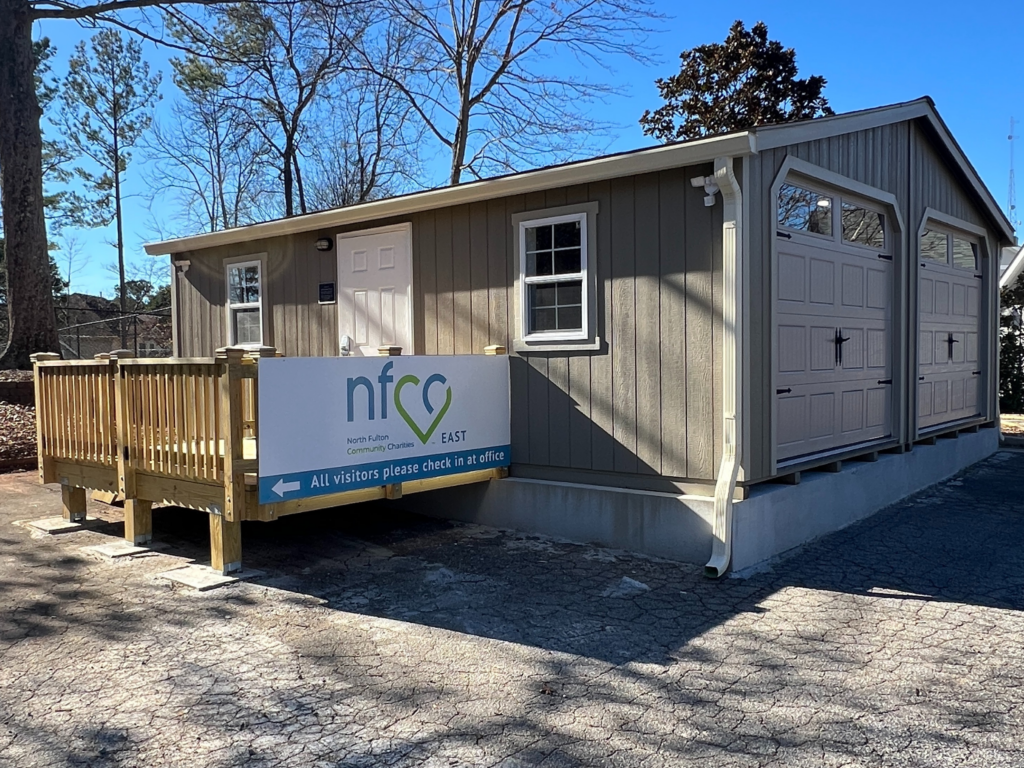
At first glance, the East Roswell pantry might surprise you. It looks like a simple shed, tucked beside the church and garden. That simplicity is intentional.
The space, just 24 x 24 feet, has been transformed wall to wall into a fully functioning food pantry designed to serve 100 families each week. It is a model built for impact and replication, one that allows NFCC to expand into other high-need areas in the future.
Inside, every detail reflects best practices from our Elkins pantry, scaled thoughtfully for a smaller footprint. Large garage doors allow food deliveries to be unloaded directly into the space. Inventory was carefully selected based on client surveys so the food offered reflects what families actually want and need.
Because space is limited, the pantry will operate through an online ordering system. Families can place their orders ahead of time, volunteers will prepare them, and clients can drive up to pick up their food after check-in. It is efficient, dignified, and designed to remove unnecessary barriers.
It may look like a shed, but it is something truly special.
Fresh Food, Grown Together
Alongside the pantry is a community garden, another powerful example of how this project came together.
VP of Operations Marten Jallad shared that fresh produce consistently ranks at the top of what pantry guests want most. Fruits, vegetables, eggs, milk, and protein are often the hardest items for families to afford, yet they are essential for health and stability.
The garden was made possible through the Leadership North Fulton Class of 2025, whose members identified food insecurity as one of the most pressing needs in the area. Working together, they raised nearly $30,000, divided responsibilities across teams, and partnered with organizations like Old Rucker Farm and the Chattahoochee Nature Center to design a thriving, sustainable space.
The produce grown here will go directly into the pantry, easing financial strain for families and offering nourishment that is both fresh and affirming.
Built by Many Hands
Every part of this pantry tells a story of community showing up.
Local partners donated lighting, drywall, flooring, and materials. TE Certified, longtime supporters of NFCC, not only helped guide the electrical work but chose to donate the entire project, ensuring the pantry would quite literally have light.
Members of the Hispanic congregation at Bridge to Grace built the stairs and patio leading up to the door for easier access.
Volunteers, faith leaders, businesses, and neighbors each contributed their time, skills, and resources. What may appear to be a simple structure is an achievement shared by many.
As Marten noted, dignity matters. Choice matters. Community matters.
An Invitation
The East Roswell Food Pantry at Bridge to Grace represents more than a new location. It reflects what happens when a community acknowledges growing need and chooses to grow in response.
This pantry will serve 100 families a week. And still, the need is greater. That is why this moment matters. It shows what is possible when we take small steps toward a bigger vision of a community where everyone can thrive.
We invite you to join us on March 11 at 11 a.m. for the official ribbon cutting. Come celebrate what has been built, honor the many partners who made it possible, and imagine what we can do next together.
Because the need is growing.
And so are we.